Golden Old Love: Reflections on Eros, Intimacy, and the Timeless Dance of the HeartIn a world saturated with fleeting digital connections and hurried affections, there exists a poignant reminder of love’s purest form captured in a single, evocative image. Titled “Golden Old Love,” this black-and-white photograph transports us to a serene meadow, where a young couple leans against the gnarled trunk of an ancient oak tree. A vintage bicycle, complete with a wicker basket, rests nearby like a faithful companion, hinting at journeys taken and adventures yet to unfold.
The woman, dressed in a high-collared blouse and a flowing skirt with striped hems, holds an open book in her lap, her dark hair neatly swept back, her expression one of quiet absorption. Beside her, the man in suspenders and a crisp shirt gazes not at the pages but at her, his strong jawline softened by an unmistakable tenderness. A blanket drapes over their legs, and the vast field stretches behind them, blurred into eternity under a soft sky. This scene, frozen in time, serves as a portal to explore the profound depths of love, eros, and intimacy—concepts that have enchanted philosophers, poets, and lovers across centuries.
Love, in its broadest sense, is the invisible thread that weaves humanity together. It is the force that propels us toward connection, urging us to transcend our solitary existences. In the image, love manifests in the simplest of settings: no grand gestures, no opulent surroundings, just two souls sharing a moment amid nature’s embrace. This echoes the ancient Greek notion of philia, the affectionate love of companionship, but it also hints at something deeper.
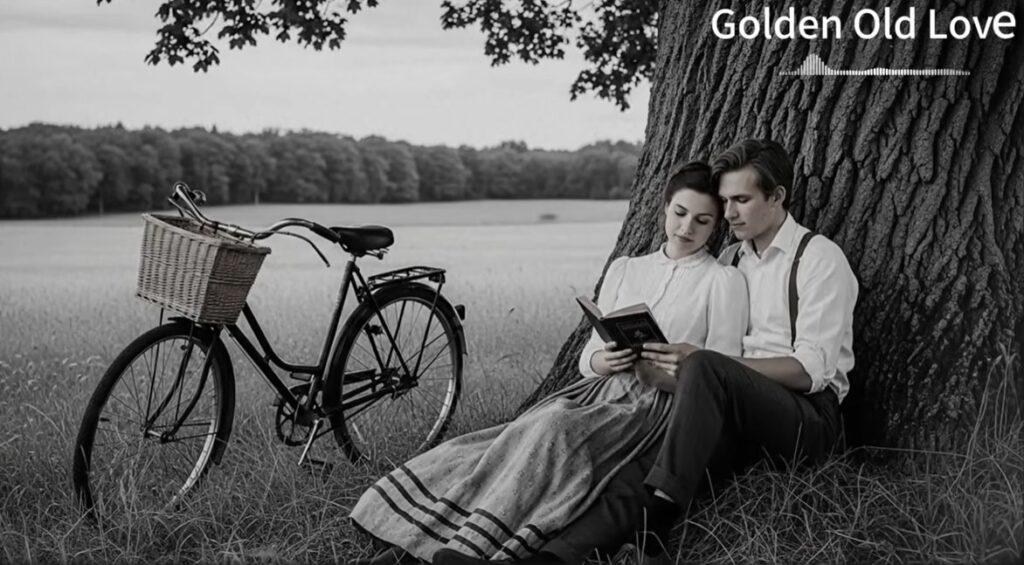
The couple’s proximity—shoulders touching, bodies aligned against the tree—symbolizes a love that is comfortable, enduring, like the oak itself, rooted and resilient. Psychologists like Robert Sternberg describe love as a triangle comprising intimacy, passion, and commitment. Here, commitment is implied in their unhurried togetherness; they have chosen this spot, this book, this day, to be with one another. Yet, love is not static; it evolves, much like the seasons that might have witnessed countless such pairings in that very field.
Reflecting on the lovers, one can’t help but wonder about their story. Are they newly acquainted, or have they weathered years together? The image’s ambiguity invites us to project our own experiences, reminding us that love is as much about perception as it is about reality.Delving into eros, the passionate and romantic dimension of love, the photograph pulses with subtle erotic energy.
Eros, named after the Greek god of desire, represents the intoxicating pull of attraction—the spark that ignites hearts and bodies alike. In modern terms, it’s the chemistry that makes palms sweat and pulses race. Look closely at the man: his eyes fixed on her face, not the book, suggest a gaze laden with longing. It’s not overt; there’s no embrace or kiss, but the air between them crackles with unspoken desire. Her slight lean toward him, the way her fingers grip the book as if anchoring herself amid swirling emotions, evokes the thrill of eros in its nascent form. Philosopher Plato, in his Symposium, portrayed eros as a ladder ascending from physical beauty to spiritual enlightenment.
In this scene, the physical—the touch of fabric, the warmth of shared space—serves as the foundation. The bicycle, perhaps a symbol of mobility and freedom, contrasts with their stillness, implying that eros has paused their journey, drawing them into a private world. Yet, eros is fleeting; it can burn brightly and fade, which is why the image’s innocence tempers it. These lovers appear unscarred by the complexities of modern romance—no distractions from screens or societal pressures.
Their eros feels pure, unadulterated, a craving that every lover harbors: the desire to be consumed by another’s presence, to feel alive in the gaze of the beloved.Intimacy, the quiet counterpart to eros’s fire, forms the emotional core of the image. It’s the vulnerability of being truly seen, the sharing of inner worlds without fear. In the photograph, intimacy blooms in the shared reading—a book acting as a bridge between minds. What words dance on those pages? Poetry by Keats, perhaps, with lines like “A thing of beauty is a joy forever,” mirroring their idyllic setting. Or a novel of forbidden love, heightening the intimacy of their seclusion.
The woman’s downward gaze and the man’s watchful one create a dynamic of giver and receiver; she shares the story, he absorbs her essence. This reflects what researcher Brené Brown calls “wholehearted” connection, where intimacy thrives on empathy and trust. The blanket over their laps adds a layer of coziness, a physical metaphor for the emotional warmth that intimacy provides. In a fast-paced era where superficial interactions dominate, this scene yearns for what many lack: undivided attention.
The lovers’ innocence—free from cynicism, their faces unmarked by worry—highlights intimacy’s restorative power. It’s the antidote to loneliness, the space where secrets are whispered and souls entwine. Every lover craves this: not just physical closeness, but the profound knowing that comes from moments like these, where time slows and hearts align.Reflecting deeper on the image, it evokes nostalgia for a “golden old” era, perhaps the early 20th century, when love unfolded at a gentler pace. The black-and-white palette strips away distractions, focusing on essence over embellishment. The tree, ancient and steadfast, symbolizes enduring love, its branches sheltering the couple like a guardian.
The field, vast and open, contrasts their intimacy, emphasizing how love carves private sanctuaries amid life’s expanse. These lovers embody archetypes: she, the muse inspiring devotion; he, the protector offering quiet strength. Yet, they transcend gender roles, united in mutual reverence. In literature, such scenes recall Jane Austen’s picnics in Pride and Prejudice, where courtship blooms in nature, or F. Scott Fitzgerald’s tender moments before the storm of passion.
Psychologically, this innocence taps into our collective unconscious, as Carl Jung might say—a yearning for archetypal harmony. But is this ideal attainable today? In an age of swipes and ghosts, the image challenges us to reclaim simplicity. Eros without intimacy risks superficiality; intimacy without eros dulls into routine.
True love balances both, as seen here.The craving for this “golden old love” is universal. Every lover desires the serenity depicted: to escape urban clamor, to sit with a partner under a tree, sharing stories that bind. It’s the dream of eros reignited through intimate gestures—a brush of hands, a shared laugh. In reflections, the image warns against modern pitfalls: over-reliance on technology eroding presence, societal expectations stifling authenticity.
Yet, it inspires hope; love’s essence remains unchanged. Couples today can recreate this— a park bench, a book, a blanket—fostering the intimacy that sustains eros. As Rumi poetically noted, “Lovers don’t finally meet somewhere. They’re in each other all along.” This image visualizes that truth.In conclusion, “Golden Old Love” is more than a photograph; it’s a mirror to our deepest longings. Through its lens, love emerges as a multifaceted gem: eros the brilliant spark, intimacy the gentle polish, together forming an unbreakable bond.
The lovers, in their innocent repose, remind us that true connection thrives in simplicity, away from the world’s noise. What every lover craves is this timeless intimacy—a love that whispers eternal promises in quiet fields, where hearts beat as one. In embracing such reflections, we honor the past while enriching our present, ensuring that golden love endures.(Word count: 1028)